
POV Meaning Explained: The Powerful Guide to What It Means in 2026
If you scroll through TikTok, Instagram, or even a group chat for more than a few minutes, you will run into the letters “POV.” It shows up in video captions, memes, texts, and even office Slack messages. For anyone who did not grow up online, it can feel like a secret code. For everyone else, it is just part of daily digital language.
This guide breaks down exactly what POV means, where it came from, how it is used in 2026, and how to use it correctly without sounding out of touch.
Quick Answer: What Does POV Mean?
POV stands for “point of view.” It describes the perspective from which something is seen, told, or experienced. Online, POV is used in captions and videos to place the viewer directly into a scene, as if they are seeing it through someone else’s eyes.
That is the short version. The rest of this guide covers how that simple definition turned into one of the most used pieces of internet slang today.
Where Does POV Come From?

POV is not a new invention from social media. The term has existed for decades in film, photography, and literature, long before TikTok gave it a second life.
- In filmmaking, a POV shot is a camera angle that shows exactly what a character sees, putting the audience in their shoes.
- In literature, point of view refers to the narrative voice, whether a story is told in first person, third person, or another perspective.
- In photography and video production, POV cameras (like helmet or chest mounted cameras) capture footage from the exact vantage point of the person wearing them.
Social media borrowed this existing term and reshaped it into something faster, shorter, and far more casual. What used to be a technical filmmaking term became everyday internet shorthand.
Read Now : NTM Meaning in Text
How POV Is Used Today
POV has grown far beyond its original meaning. Depending on where you see it, it can mean slightly different things.
POV on TikTok and Instagram
This is where POV became a full blown trend. Creators use “POV:” at the start of a caption, followed by a scenario, to make viewers feel like they are living the moment themselves rather than just watching it.
Common examples include:
- “POV: You are the last customer before the store closes.”
- “POV: Your best friend just found out your secret.”
- “POV: It is 2 AM and you cannot sleep.”
The video is filmed or acted out so the viewer feels present in the situation, not like an outside observer.
POV in Text Messages and Chat
In texting, POV is often used more loosely. It sets up a relatable, funny, or dramatic situation without needing an actual video attached.
Example: “POV: you just realized you left your charger at home again.”
Here, POV works almost like a storytelling trigger. It signals “imagine this” rather than describing a literal visual perspective.
POV as a Statement of Opinion
Outside of video content, people also use POV in a more conversational way, almost like saying “in my opinion” but with a bit more confidence. Instead of hedging with “I think,” saying something is “my POV” signals ownership of that viewpoint.
Example: “My POV is that the meeting could have been an email.”
This usage carries a stronger sense of conviction than a simple opinion. It suggests the person is not just guessing, but genuinely standing behind what they are saying.
POV in Memes
Meme culture leans heavily on POV to create relatable or funny moments. A meme captioned “POV: you are the group project member who did all the work” instantly places the viewer inside a familiar, often humorous scenario. It works because it invites the audience to project themselves into the joke rather than just read about it.
POV Meaning by Platform: Quick Comparison
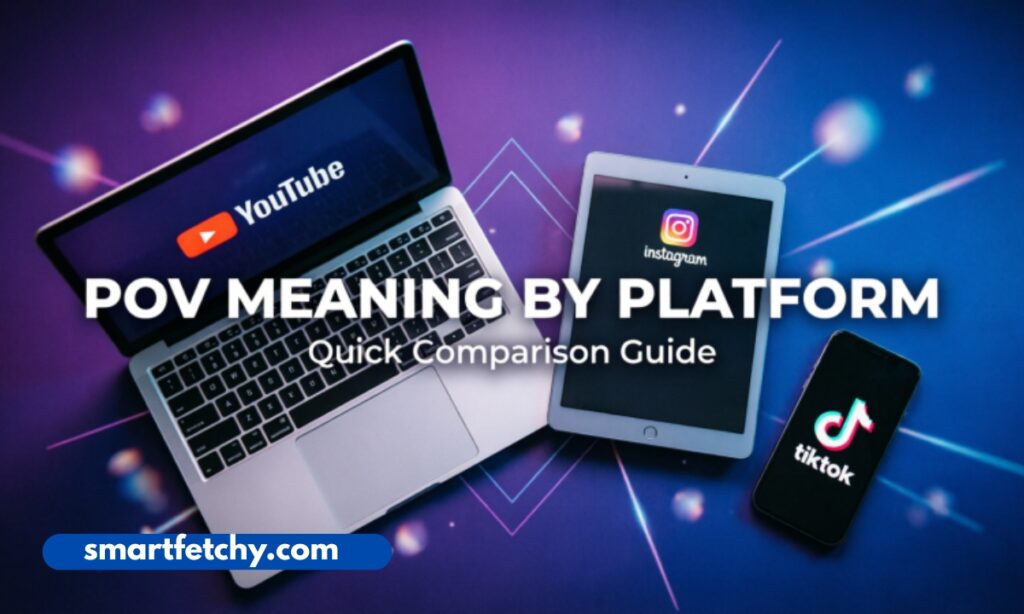
| Platform or Context | How POV Is Used | Example |
| TikTok | First-person video from the creator’s perspective | “POV: you are the manager on a Friday closing shift” |
| Captions or reels placing viewer in a scene | “POV: it’s your first day at a new job” | |
| Text messages | Setting up a relatable or funny situation | “POV: you just hit send on the wrong chat” |
| Casual conversation | Sharing a firm opinion | “POV, that movie was overrated” |
| Film and photography | Camera angle matching a character’s eyesight | A first-person shot during an action scene |
| Literature | The narrator’s perspective in a story | A novel written in first-person POV |
Read Also : ABG Meaning Explained
Is POV the Same as “In My Opinion”?
Not exactly. This is one of the most common mix-ups people have, so it is worth clearing up.
- “In my opinion” (IMO) is a straightforward way to introduce a personal view. It is neutral and often used to soften a statement.
- POV carries a bit more intensity. It often implies “this is how I genuinely see it” or “step into my shoes for a second,” rather than just offering a passing thought.
So while the two overlap, POV tends to feel more immersive and a little more assertive than a simple opinion marker.
Is POV always sarcastic?
No. POV can be sincere, dramatic, funny, or sarcastic depending on context. A caption like “POV: watching the sunset with your best friends” is sincere and warm. A caption like “POV: you told everyone you were ‘almost done’ three hours ago” leans sarcastic. The tone comes entirely from the situation being described, not from the word POV itself.
Can POV be used in professional settings?
Generally, no. POV is casual internet language and does not belong in formal emails, reports, or business presentations. It is fine in informal team chats or casual internal messaging, but it should be avoided in client-facing or formal writing.
Does POV always need a video attached?
No. While POV started as a video and film term, its text and caption usage has completely detached from needing visuals. A text message or meme caption using POV works perfectly well without any video content at all.
Is POV only for younger generations?
Not anymore. While it started as Gen Z and younger millennial slang, POV has become widely understood across most age groups by 2026, largely because it appears constantly across mainstream platforms, ads, and even news headlines. Older audiences may not use it themselves, but recognition has grown significantly.
What’s New With POV in 2026
Slang evolves fast, and POV has picked up a few new layers recently that older explainer articles have not fully covered.
- POV has moved into AI generated content. With AI video tools becoming mainstream, creators now prompt AI to generate “POV style” clips, meaning first-person perspective videos, without ever filming anything themselves. The phrase has shifted from describing how something was filmed to describing a visual style that can now be artificially generated.
- Brands are using POV in marketing captions. Companies increasingly write product ads as “POV: you finally found a coffee that doesn’t taste burnt,” borrowing the format to make advertising feel more like organic social content.
- POV is showing up in voice search and AI chat queries. People are now asking digital assistants things like “what does POV mean” directly, rather than typing it into a search bar, which is part of why clear, direct definitions matter more than ever.
- Workplace usage is rising. POV has quietly slipped into casual workplace messaging apps as a lighter way to share a viewpoint during brainstorming, especially among younger employees.
How to Use POV Correctly
If you want to use POV naturally without sounding forced, keep these guidelines in mind.
- Start with “POV:” followed by the scenario, not a full explanation.
- Keep it short. The best POV captions are one sentence, not a paragraph.
- Match the tone to the situation, whether that is humor, sincerity, or drama.
- Avoid using it in formal writing, resumes, or professional emails.
- Use it to invite someone into a moment, not just to state a fact.
Common Mistakes People Make With POV
- Using POV followed by a third-person description instead of a first-person scenario, which breaks the immersive effect.
- Overusing POV in every caption, which makes it lose impact.
- Confusing POV with simply saying “imagine if,” when POV specifically implies experiencing something through someone’s eyes.
- Assuming POV always means a literal video, when in modern usage it frequently works as pure text.
Final Thoughts
POV started as a filmmaking term, grew into a literary device, and has now become one of the most flexible pieces of internet language in use today. At its core, the meaning has not changed much: it is still about seeing something from a specific perspective.
What has changed is how widely and creatively people apply it, from TikTok captions to office chats to AI generated videos. Once you understand the core idea, spotting and using POV correctly becomes second nature, no matter where you run into it.

Welcome to SmartFetchy.com your go-to source for heartfelt prayers, inspiring prayers, meaningful quotes, and uplifting messages for every special moment. We create thoughtful and easy-to-share content that helps you express love, gratitude, faith, and happiness with the right words.