PS Meaning in Text: Powerful Slang Guide You Need (2026)
You are scrolling through a text from a friend, and right at the bottom, after everything else has already been said, you see two letters: PS. It feels tacked on, almost like an afterthought, but it is doing more work than you might think. If you have ever paused and wondered what someone actually meant by it, you are not alone. Thousands of people type “PS meaning in text” into Google every month, and most of them get answers that are either too long, too formal, or missing the actual texting context.
This guide fixes that. Below you will find the real meaning of PS, how it is used in 2026 chat culture, how it shows up differently across Instagram, Snapchat, and WhatsApp, and how to reply to one without sounding awkward.
What Does PS Mean in Text?
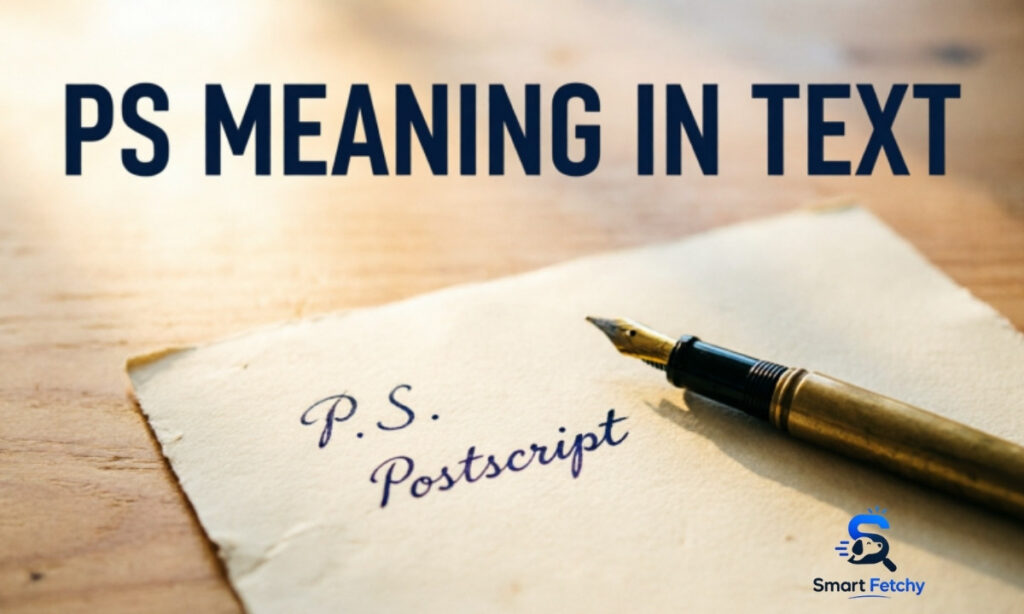
PS stands for “postscript,” a short note added after the main part of a message. In texting, it is used to include an extra thought, reminder, joke, or feeling that did not fit naturally into the first message. It usually appears at the very end, often as its own short line.
Read Slang : HW Meaning in Text
Where the Abbreviation Actually Comes From
PS did not start online. It comes from letter writing, long before texting existed. The term comes from the Latin phrase “post scriptum,” which simply means “written after.”
Back when letters were handwritten, there was no way to go back and insert a missed sentence in the middle of a paragraph. If a writer signed off and then remembered something important, the only option was to add it below the signature, labeled PS.
That habit carried into typed letters, then emails, and now texts and social captions. The format changed completely, but the purpose stayed almost identical: it is still the spot for the thing you almost forgot to say.
Read Now : JW Meaning in Text
How People Use PS in Texting Today
In modern chats, PS rarely carries the formal weight it once had. It has turned into a flexible little tool that people use for all kinds of tones.
Here is what it typically signals in a casual conversation:
- A reminder that almost got left out
- A joke or teasing comment added after a serious message
- An emotional line that felt easier to say last
- A quick update that does not need its own separate text
- A playful or dramatic flourish at the end of a message
For example, someone might text “See you at 7” and then follow it with “PS I’m bringing snacks.” The main message is complete on its own. The PS line adds a small bonus without changing the point of the text.
Why People Still Bother Adding It
A one word reply or a second text would do the same job technically, but PS gives that extra line a bit of personality. It signals “this part is separate, but I still wanted you to see it.” That small distinction is why it has stuck around through decades of changing slang.
PS in Different Types of Conversations

The tone behind PS shifts depending on who is texting and why. The table below breaks down how it typically lands in different situations.
| Context | Common Use of PS | Example |
| Friends | Playful or joking add on | “Running late. PS you owe me coffee” |
| Dating or flirting | Soft, personal, sometimes vulnerable | “Had a great time tonight. PS I already miss you” |
| Family | Reminders or small updates | “Home safe. PS mom called, call her back” |
| Work or professional chat | Quick, relevant follow up point | “Sent the file. PS deadline moved to Friday” |
| Social media captions | Extra commentary or humor | “New haircut. PS don’t ask what happened” |
Notice that the letters stay the same across every context. What changes is tone, and tone is usually carried by the words that follow PS rather than the abbreviation itself.
PS vs Similar Texting Abbreviations
PS is often grouped with other short forms, but it does not mean the same thing as most of them. Mixing these up is a common source of confusion, especially for people newer to texting slang.
| Abbreviation | Meaning | Typical Feel |
| PS | Postscript, an extra note added after | Personal, sometimes dramatic or playful |
| BTW | By the way | Quick, casual, informational |
| FYI | For your information | Direct, practical, sometimes neutral or blunt |
| TBH | To be honest | Used before a personal opinion |
| IIRC | If I recall correctly | Used when someone is not fully certain about a fact |
The easiest way to tell them apart: FYI usually sounds like a fact being passed along, BTW sounds like a quick side comment, and PS sounds like something the sender wanted to add on purpose, almost like a small afterthought they still cared enough to include.
How to Reply to a PS Text
Replying to a PS line is not complicated, but ignoring it completely can come across as if you did not read the full message. A short acknowledgment is usually enough.
Some simple ways to respond:
- Reply to the main message first, then address the PS line briefly
- Use your own PS in the reply to keep the exchange playful
- Ask a quick follow up question if the PS mentioned something new
- Add a short reaction like “noted” or “got it” if the PS was just a reminder
If someone adds a PS that feels emotional or personal, it usually deserves more than a one word reply. That kind of PS is often where the real point of the message was hiding.
PS Meaning Across Different Platforms
PS shows up slightly differently depending on where you see it, even though the core meaning stays the same.
| Platform | How PS Usually Appears |
| Text messages (SMS/iMessage) | Added as a follow up line after the main text |
| Common in longer chats, often used for reminders | |
| Instagram captions | Used for humor, extra context, or a personal aside |
| Snapchat | Often teasing or joking, matched with the casual tone of the app |
| Still used in the more traditional, formal sense |
Email is really the last place PS still behaves close to its original letter writing purpose. Everywhere else, it has loosened up into something closer to a stylistic habit than a strict rule.
Common Mistakes People Make With PS
A few small misunderstandings come up again and again, so it helps to clear them out early.
- Thinking PS only belongs in formal writing. It is now just as common in casual texts and captions.
- Assuming PS always signals something serious. Most of the time it is lighthearted.
- Confusing it with PPS. PPS simply means a second postscript, an additional note after the first one.
- Overusing it in every message. When every text ends in a PS, it loses its impact and starts to feel like a habit rather than a genuine addition.
- Reading too much into it. Sometimes a PS really is just a small reminder, not a hidden emotional signal.
Is PS Still Used in 2026?
Yes, and it has actually held up better than a lot of slang from the same era. New abbreviations come and go constantly, but PS keeps showing up in texts, captions, and even voice message transcripts.
A few reasons it has stayed relevant heading into 2026:
- It is short enough to type without slowing down a conversation
- It works across almost every messaging platform without needing explanation
- It fits both playful and sincere tones, so it has not been boxed into one meaning
- Younger users have picked it up online even without ever writing an actual letter
- It pairs naturally with emojis and voice notes, which keeps it feeling current rather than dated
What has shifted is not whether people use it, but how. The formal, business letter version of PS has mostly stayed in emails and official documents. The texting version has become more emotional and more humorous, often used to soften a message, add a joke, or slip in something the sender was slightly nervous to say directly.
There is also a newer pattern worth mentioning. In group chats and social captions, some people now use PS almost like a mini punchline, saving the funniest or most unexpected line for last on purpose. It plays the same role a good closing line plays in a short video or a caption, which is part of why it still feels natural on platforms built around quick, scroll friendly content.
Other Meanings of PS You Should Know
PS is not always about postscript. Depending on where you see it, it can stand for something completely different.
| Meaning | Where It Is Used |
| Postscript | Texts, emails, letters |
| PlayStation | Gaming conversations, often written as “PS5” |
| Per second | Technical or scientific contexts |
| Public School | Education, especially in the US |
| Photoshop | Design and creative communities |
Context almost always makes the correct meaning obvious. A message ending in “PS I love you” is clearly a postscript. A message about buying a new console is clearly talking about PlayStation.
Frequently Asked Questions
What does PS mean from a girl in texting?
It carries the same core meaning, an added note after the main message. The tone often leans personal or affectionate, since PS is frequently used to add a feeling that felt easier to include at the end rather than in the middle of the text.
Is PS considered flirty?
It can be, depending on what comes after it. PS itself is neutral. It is the sentence following it, something warm, teasing, or a little vulnerable, that gives it a flirty tone.
What is the difference between PS and PPS?
PS is the first added note after a message. PPS is a second note added after the PS, used when someone wants to include yet another point without editing what they already wrote.
Can PS be used in professional messages?
Yes. In work emails, it is still commonly used to highlight a deadline, a reminder, or a small detail that supports the main message without needing its own paragraph.
Does PS mean the same thing on every app?
The core meaning stays the same everywhere. What changes is tone. Email keeps it closer to formal, while texting apps and social captions lean casual, playful, or personal.
Final Thoughts
PS has survived centuries of changing communication styles because it solves a simple problem: sometimes the most important part of a message comes to mind right after you think you are done.
Whether it shows up in a work email, a group chat, or a caption, it still does the same basic job it always has, giving the sender one more line to say what almost got left out. Understanding it takes seconds, but using it well can make a short text feel a little more thoughtful, funny, or personal, depending on what you need it to do.

Welcome to SmartFetchy.com your go-to source for heartfelt prayers, inspiring prayers, meaningful quotes, and uplifting messages for every special moment. We create thoughtful and easy-to-share content that helps you express love, gratitude, faith, and happiness with the right words.