
ETA Meaning: The Complete Guide to What It Really Means in 2026
You have seen it on delivery apps, flight boards, work chats, and even text messages from friends running late. Three letters, one question everyone eventually asks: what does ETA actually mean?
This guide breaks down every common use of ETA, from everyday texting to shipping, travel visas, and business operations. By the end, you will know exactly what ETA means in any context and how to use it correctly yourself.
What Does ETA Mean? (Quick Answer)
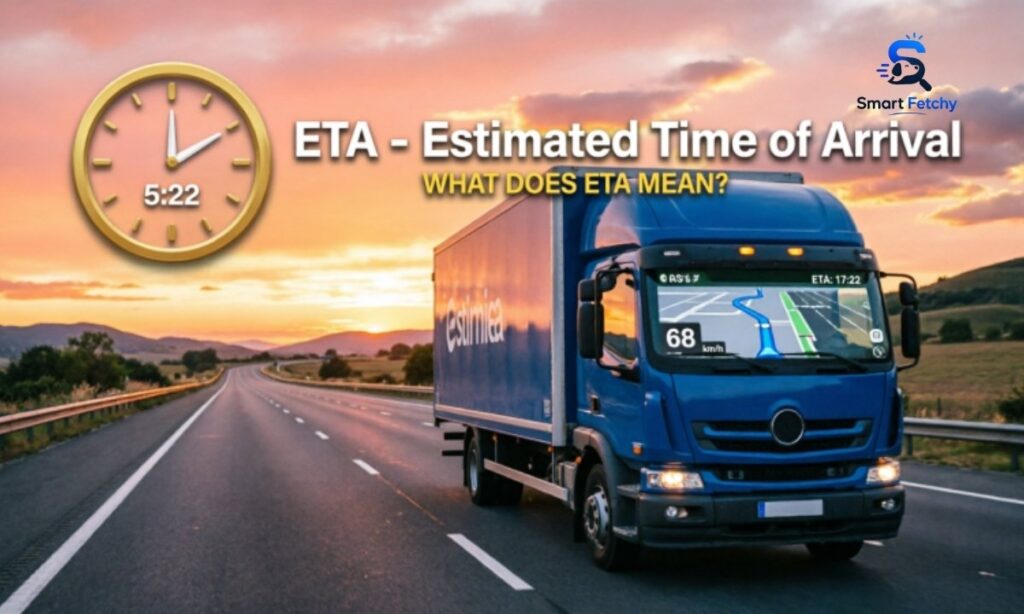
ETA stands for Estimated Time of Arrival. It is the predicted date or time at which a person, vehicle, shipment, or service is expected to reach its destination. ETA is not a guarantee, it is a forecast based on distance, speed, and current conditions, and it can shift as those conditions change.
That is the short version. Now let’s look at where the term came from, how it is used across different industries, and how you can calculate or communicate an ETA correctly.
Read Now : TDY Meaning in Text
Where Does the Term ETA Come From
ETA started as a technical term used by ships, trains, and later aircraft to communicate arrival forecasts to ports, stations, and control towers. Before GPS and live tracking, dispatchers relied on speed, distance, and known travel routes to estimate when a vessel or train would reach its destination.
Over time, the phrase moved from professional radio communication into everyday English. Today it shows up everywhere, from a courier app telling you your package is fifteen minutes away, to a coworker texting “ETA 10 minutes” before a meeting.
The Core Meaning of ETA in Everyday Use
At its simplest, ETA answers one question: when will you get here?
People use it to:
- Tell someone when they will arrive at a meeting, party, or pickup point
- Track a food delivery or rideshare in real time
- Communicate flight or train arrival times
- Update a team on when a task or project will be finished
Example texts:
- “On my way, ETA 20 minutes.”
- “Package ETA is tomorrow by 6 PM.”
- “Flight ETA has been pushed back due to weather.”
In casual conversation, ETA has almost fully replaced the longer phrase “estimated time of arrival” because it is faster to type and just as clear.
ETA in Logistics and Shipping

In supply chain and logistics, ETA carries real financial and operational weight. It is the projected time a shipment, container, or vehicle will reach its destination, and businesses build entire schedules around it.
Freight forwarders, warehouse managers, and retailers use ETA to:
- Plan staffing and dock space at warehouses
- Coordinate customs clearance in advance
- Set accurate delivery windows for customers
- Reduce the number of “where is my order” support tickets
An ETA in shipping is calculated using variables like distance remaining, current speed, historical route data, weather, port congestion, and customs processing time. Because so many of these factors can change quickly, a shipping ETA is always treated as an estimate rather than a fixed promise.
Read Now : IYKYK Meaning in Text
ETA vs Other Logistics Terms
Businesses often pair ETA with a handful of related abbreviations. Mixing these up is one of the most common mistakes in logistics communication.
| Term | Full Meaning | What It Tells You |
| ETA | Estimated Time of Arrival | When the shipment or vehicle is expected to arrive |
| ETD | Estimated Time of Departure | When the shipment or vehicle is expected to leave |
| ETC | Estimated Time of Completion | When a task or process is expected to finish |
| ETS | Estimated Time of Shipping | When an order is expected to leave the warehouse |
| EDD | Estimated Delivery Date | The date a customer can expect to receive an order |
Knowing the difference matters. An ETD tells a customer when their order left the facility, while an ETA tells them when it will show up at their door. Confusing the two leads to unnecessary confusion and support requests.
ETA in Travel: Electronic Travel Authorization
There is a second, completely different meaning of ETA that has become far more common in 2026: Electronic Travel Authorization. This is a government-issued travel permission, not a time estimate, and it is easy to confuse the two if you only skim a headline.
Several countries now require travelers to apply for an ETA before boarding a flight, even if they do not need a full visa.
- The United Kingdom requires an ETA for many visa-exempt visitors, including travelers from the United States, Canada, and Australia, for stays of up to six months.
- Canada has required an eTA for visa-exempt air travelers for several years, and it remains mandatory for most eligible nationalities in 2026.
- The European Union’s long-planned ETIAS, a similar electronic authorization system for the Schengen area, has continued to shift its rollout timeline, so travelers should always check the current requirement before booking.
An electronic travel authorization is usually applied for online, linked electronically to a traveler’s passport, and does not guarantee entry on its own. Border officers still make the final decision when a traveler arrives.
ETA (Time) vs ETA (Travel Authorization)
| Aspect | ETA as Estimated Time of Arrival | ETA as Electronic Travel Authorization |
| What it measures | A predicted time or date | A government travel permission |
| Common context | Shipping, texting, flights, delivery apps | International travel to the UK, Canada, and similar countries |
| Can it change | Yes, based on conditions | No, it is a fixed approval tied to your passport |
| Cost | Free, it is just a prediction | Usually a small paid application fee |
| Where you find it | Tracking apps, texts, logistics dashboards | Government immigration websites |
If you are reading an article about visiting another country, ETA almost always means travel authorization. If you are reading about a delivery, flight, or shipment, it almost always means time of arrival.
ETA as a Greek Letter
Before it was an abbreviation, eta was already a word. It is the seventh letter of the Greek alphabet, written as Η in its capital form and η in lowercase. It shows up in physics, statistics, and engineering as a symbol for variables like efficiency or effect size. This meaning has nothing to do with arrival times, but it explains why you might see “eta” defined this way in a dictionary before the abbreviation is even mentioned.
How to Calculate an Accurate ETA

Whether you are texting a friend or managing a delivery fleet, a good ETA depends on a few consistent factors.
- Distance remaining. The straight line or route distance left to travel.
- Current speed or pace. Real-time speed, not an assumed average.
- Route conditions. Traffic, weather, road closures, or port congestion.
- Historical data. Past performance on the same route helps refine predictions.
- Buffer time. A small cushion for loading, customs, or last-minute delays.
Modern ETA tools no longer rely on simple math like distance divided by speed. Delivery apps, airlines, and shipping platforms now use live GPS data combined with machine learning models that adjust predictions continuously as new information comes in. This is why a delivery ETA might shift by a few minutes as your driver hits traffic, rather than staying fixed the entire trip.
What Is New About ETA in 2026
A few things have shifted the way ETA is used and understood recently.
- AI-adjusted ETAs are now standard, not a premium feature. Most major delivery, rideshare, and shipping platforms recalculate arrival predictions in near real time using live traffic and historical pattern data, which has made single-point ETAs noticeably more accurate than they were just a few years ago.
- Electronic travel authorization programs have expanded. More countries have either launched or continued rolling out ETA and ETA-style systems for visa-exempt travelers, which means the travel-authorization meaning of ETA is showing up in search results and everyday conversation far more than it used to.
- Predictive ETA in shipping has moved from experimental to expected. Freight companies increasingly advertise predictive accuracy in hours rather than days, and customers now expect similar precision from small businesses that they once only expected from major carriers.
- ETA has fully settled into workplace shorthand. Project managers now use “ETA” interchangeably for task deadlines, not just physical arrivals, asking things like “what’s your ETA on that report” as normal, accepted phrasing.
Common Questions About ETA
What does ETA mean in texting?
In texting, ETA means estimated time of arrival. Someone asking “what’s your ETA” wants to know how long until you arrive or how much time is left before something happens.
Is ETA the same as ETD?
No. ETA is when something arrives, while ETD is when something departs. They describe opposite ends of the same trip.
Does ETA mean the same thing everywhere?
Not quite. In texting, shipping, and travel apps, ETA almost always means estimated time of arrival. In immigration contexts, especially for countries like the UK and Canada, ETA can mean electronic travel authorization, which is a travel permit rather than a time prediction.
How accurate is a typical ETA?
Accuracy depends on the context. Real-time tracking apps using live GPS and traffic data are usually accurate within a few minutes. Longer-distance shipping ETAs, especially international freight, can shift by hours or even days due to customs, weather, or port congestion.
Can an ETA change after it is given?
Yes. An ETA is a prediction, not a fixed commitment. Traffic, weather, mechanical issues, customs delays, or route changes can all cause an ETA to be updated before arrival.
What does ETA stand for besides estimated time of arrival?
Depending on context, ETA can also stand for Electronic Travel Authorization in immigration settings, or refer to eta, the seventh letter of the Greek alphabet, in academic and scientific writing.
Final Thoughts
ETA is a small abbreviation that carries a lot of meaning depending on where you see it. In a text message or delivery app, it tells you when to expect someone or something. In logistics, it drives real planning decisions. In travel, it can mean a government authorization rather than a time at all.
The safest approach is simple: check the context before you assume the meaning. Once you know whether you are dealing with a time prediction or a travel authorization, the rest of the term makes perfect sense.

Welcome to SmartFetchy.com your go-to source for heartfelt prayers, inspiring prayers, meaningful quotes, and uplifting messages for every special moment. We create thoughtful and easy-to-share content that helps you express love, gratitude, faith, and happiness with the right words.